

 FAQ — Fat Pad Syndrome
Q: How is fat pad syndrome diagnosed?
A: Usually through a clinical assessment — your physio will assess your movement, palpate the knee and can identify the characteristic signs. Occasionally an MRI is used to confirm it.
Q: Can I still exercise with fat pad syndrome?
A: Often yes, but it depends on what’s aggravating it. Your physio will guide you on what to keep doing, what to modify, and what to avoid temporarily.
Q: How long does it take to heal?
A: Mild cases can settle in 4–6 weeks. More persistent cases may take 3–4 months, especially if left untreated for a while.
Q: Do I need a referral to see a physio?
A: No referral needed — you can book directly with us at Arana Hills Physiotherapy.
Q: Will I need surgery?
A: Rarely. The vast majority of cases resolve well with physiotherapy alone.
If you’ve got a nagging ache underneath or around your kneecap — especially one that flares up when you straighten your leg, sit for too long, or go down stairs — there’s a good chance you’re dealing with something called fat pad syndrome. And if you’ve never heard of it, you’re not alone. It’s one of the more underdiagnosed causes of knee pain we see here at Arana Hills Physiotherapy.
So, what actually is it?
A Quick Look at the Knee — and Why the Fat Pad Matters
 The knee is one of the most complex joints in the body. It’s made up of three bones — the femur (thigh bone), tibia (shin bone), and patella (kneecap) — held together by a network of ligaments, tendons, and cartilage.
Sitting just below the kneecap, nestled between the patellar tendon at the front and the joint itself at the back, is the infrapatellar fat pad — sometimes called Hoffa’s fat pad.
This structure is made up of soft, fatty tissue and is one of the largest soft tissue structures inside the knee.
Its primary role is shock absorption: it cushions the joint during loading, helps distribute pressure evenly across the knee, and acts as a protective buffer between the moving parts of the joint. It’s also richly supplied with nerve endings, which is exactly why irritation here can produce pain that feels quite sharp and intense, even from what seems like a minor injury.
So What Is Fat Pad Syndrome?
 When this fat pad gets pinched, compressed, or inflamed — usually from repetitive movement, a direct knock, or poor biomechanics — it becomes swollen and hypersensitive.
Every time the knee straightens and the space around the fat pad narrows, it gets squeezed, which perpetuates the pain cycle. This is what we call fat pad syndrome, or Hoffa’s syndrome.
What Does Fat Pad Knee Pain Feel Like?
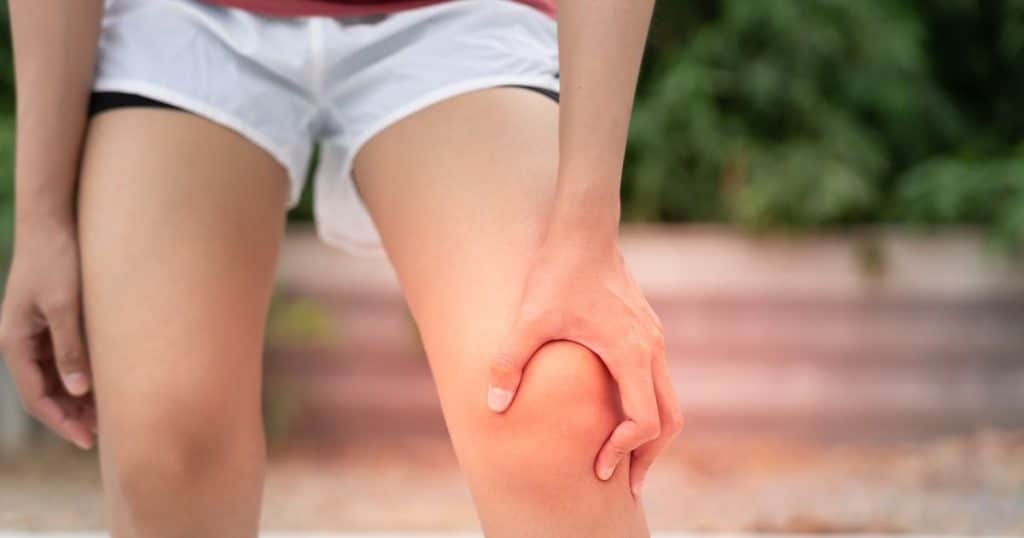
The pain is usually felt at the front of the knee, just below the kneecap. You might notice it:
- After sitting with your knee fully extended
- When walking downstairs or downhill
- During activities that involve repeated knee straightening, like cycling or running
- When pressing around the lower edges of your kneecap
In some cases the area looks puffy, and the pain can be sharp or a constant dull ache — it really does vary from person to person.
What Causes Fat Pad syndrome ?
Fat pad syndrome most commonly develops from things like:
- A sudden increase in training load (hello, new running program)
- A direct impact to the front of the knee
- Muscle weakness around the hip and knee altering how your kneecap tracks
- Hyperextension of the knee — where the joint bends slightly backward
It shows up in both active people and those with more sedentary lifestyles, so it’s not just a “runner’s problem.”
The Good News — Fat Pad pain Responds Really Well to Physio
At Arana Hills Physiotherapy, we take a thorough look at what’s driving your pain. Treatment typically involves hands-on therapy to reduce inflammation and improve movement, taping or bracing to offload the fat pad, and targeted strengthening of the muscles that support your knee and hip. We’ll also help you modify your activities in the short term so you’re not constantly winding yourself back to square one
Most people see a meaningful improvement within a few weeks when they stick to a plan.
If you need help with knee pain you can book in with a member of our team below
Book online here