

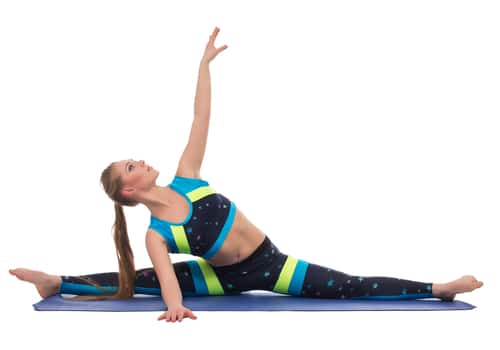
There is a certain irony in this blog in that i am the least flexible or diligent stretcher ! My intentions are there but my actions certainly are not.
 Stretching has long been a part of peoples exercise programs for recreation, sport and managing various injuries and often people think stretching is essential to improving flexibility. It is a comment we here in the clinic a lot that when people have back pain they often comment ” my hamstrings are tight , i think i need to stretch them”.
We see runners stretch their hamstrings before going for a run , gymnasts do hyper-splits during their warm-ups and yogis wind down their practice with some forward bends and various other contortions.
But does stretching really prevent tight hamstrings and help with everything from back pain to sporting performance? And if it does , how does it work and what’s the best way to go about it?
Does stretching work and how does it work ?

-
Improving flexibility with stretching.
There is certainly evidence that stretching can increase flexibility and joint range of motion. We don’t really know how stretching works but it is most likely a balance between the following :
- Nervous system activity and flexibility
The muscles, tendons and other soft tissue have a natural baseline level of activity called “tone”. This muscle tone is the result of how active the nervous system is at any given time. It is thought that flexibility type training decreases this resting tone to give us more flexibility and movement.
That’s why a person under anesthesia, whose nerves are quieted, can be stretched through a full range of motion with no resistance !
- Muscle and tendon length and flexibility
In the early days / weeks of stretching most changes are due to neural changes but the longer you persist with stretching then the tissue will show structural change. In experiments it took 6-8 weeks of casting a limb in a lengthened position to see structural lengthening in the muscle tissue.

-
Injury prevention and stretching.
This is a fairly contentious point as studies have shown mixed results regarding stretching and injury prevention. Most research suggests that adding stretching to warm up doesn’t prevent overuse injuries. There is evidence though that it may reduce acute muscle related strains and tears.
The theory behind stretching to prevent injury is reasonable. Stretching makes the muscle–tendon system more compliant meaning it can tolerate larger force production at longer muscle lengths. This means that when the muscle is stronger and more resistant to injury at increased lengths.
-
Improving sports performance with stretching.
 Studies have shown that stretching can reduce the amount of force that can be produced for up to an hour afterwards. This is obviously not a desired effect that we want for sporting activities.
However its a balancing act where by we can get the body primed with the appropriate range of motion and movement patterns but also able to produce the power and speed needed.
Different types of stretching
We can separate stretching into 4 different forms:
Static Stretching
This is the most common stretching technique used and is either done on your own or with a partner applying an external force. It is usually performed by extending the targeted muscle group to its maximal point and holding it for 30-60 seconds. This is often repeated 3-4 times for that muscle group.
Dynamic Stretching
dynamic stretching requires the use of continuous movement patterns that are similar or specific to exercises or skills about to be performed. dynamic stretching is often used warm ups have been shown to be superior to static stretching and warm ups for performance prior to competition.
Ballistic Stretching
Similar to dynamic stretching It involves fast “bouncing” movements where a double bounce is performed at the end range of movement. Like dynamic stretching this is typically used more for sporting related warm up rather than rehab purposes.
The bouncing movements trigger the stretch reflex and may cause increased risk for injury but can be performed in a safer manner when performed from slow speed to higher speed movements and done after static stretching.

PNF, proprioceptive neuromuscular facilitation.
Proprioceptive Neuromuscular Facilitation (PNF) is a stretching technique used to improve muscle length and joint range. It is often done with a partner and uses short duration s, ( 5-10 seconds), of contracting a stretched muscle against resistance.
It is thought that it works by causing the muscles to relax by changing the nervous system activity to the muscle.
Popular ways to do this are:
- Hold-relax
- Perform a passive 10-second pre-stretch.
- Hold and resist force applied by a second individual, causing an isometric contraction in the target muscle group, for 5-8 seconds.
- Relax the muscle group and allow a passive stretch; hold for 30 seconds to increase range of motion (ROM).
- Contract-relax
- Perform a passive 10-second pre-stretch.
- A second individual applies resistance, counteracting the client’s force of concentric contraction of the target muscle group, without completely restricting the joint through its ROM.
- Relax the muscle group and allow a passive stretch; hold for 30 seconds to increase ROM.
A flexible summary of stretching
However there is always the issue that if stretching makes you “feel” ready to play or that you can exercise or train in a more positive fashion then it’s an important part of your preparation.
One thing i can tell you for sure is that just thinking about stretching is certainly not effective !
If you want to see how you can combine all these stretching methods check out our next blog:
Cheers
Dave
